
The Data Foundation of Regulatory Change Management
Regulatory reporting depends on information collected, processed and validated across multiple systems and processes. When reporting requirements evolve, institutions need to understand not only what has changed, but also how that change affects the data behind their reports. A clear, consistent data foundation can make that process much easier to manage. A unified data model supports consistency A unified data model provides a structured basis for organising the information used across regulatory reporting processes. It can help institutions maintain consistent definitions and mappings and understand how the same data may support different reporting requirements. When requirements change, this structure provides a clearer basis for identifying which data elements and processes may need to be reviewed or adapted. Data lineage provides visibility Understanding where data comes from and how it moves through the reporting process is equally important. Data lineage provides visibility over the path from source information through transformations and calculations to the final reporting output. This helps teams investigate discrepancies, understand dependencies, and identify which parts of a reporting process may be affected when a requirement changes. Validation supports controlled implementation Regulatory reporting also depends on effective validation. Validation capabilities allow institutions to assess data against defined rules and identify issues that require attention. When reporting requirements change, relevant validation rules may also need to be reviewed alongside data mappings, calculations and reporting outputs. Keeping these elements aligned supports greater consistency throughout implementation and ongoing reporting. Bringing the elements together A unified data model, data lineage and validation serve different but complementary purposes. Together, they help financial institutions understand their data environment, assess the impact of change and maintain greater control over regulatory reporting processes. At Prognosys, these capabilities support our broader approach to Regulatory Change Management, combining regulatory expertise, technology and continuous regulatory maintenance to help institutions adapt as requirements evolve. Regulatory change may begin with a new requirement, but effective implementation depends on understanding how that requirement flows through the institution’s data and reporting environment.
Regulatory Change Management in Practice
For financial institutions, regulatory change rarely affects a single process.A new or amended requirement can influence the data an institution needs, the calculations applied to that data, the validation rules used to check it and the reporting outputs ultimately produced.This is where Regulatory Change Management becomes important: connecting evolving requirements with the practical changes needed across data, systems, processes and reporting. Understanding the impact of changeThe starting point is to understand how a new or amended requirement affects the institution’s existing reporting environment.What information is required? Where does that information come from? How is it processed? Which calculations, controls or outputs may need to change?Answering these questions helps institutions identify the scope of implementation and understand which processes, systems and teams are affected. Connecting requirements with data and systemsOnce you understand the impact, the next step is implementation.This may involve updating data mappings, revising calculations, adapting validation rules or changing report structures.A structured data environment and clear visibility over how information is processed make this work easier to manage. They help institutions understand the relationship between source data, transformations and reporting outputs, while supporting greater consistency as requirements evolve. Managing change beyond implementationRegulatory change does not end when a new requirement has been implemented.Reporting frameworks continue to evolve, and institutions need to maintain their systems and processes accordingly. This makes ongoing regulatory maintenance an important part of effective Regulatory Change Management.Close collaboration between regulatory, technology and implementation teams can help institutions adapt their reporting environments as new requirements emerge. The Prognosys approachAt Prognosys, our Regulatory Change Management approach builds on more than 20 years of regulatory reporting experience.Through the Financial Reporter Compliance Suite (FRCS), supporting data management solutions and specialist services, we help financial institutions connect evolving requirements with the data, processes and controls needed for implementation.Our focus is practical: combining regulatory knowledge, technology and implementation experience to help institutions manage change across complex reporting environments.
What “Report Once” Could Mean for the Future of Regulatory Reporting
Financial institutions have spent years managing regulatory reporting through multiple frameworks, templates and submission processes. The same underlying information may be requested for different purposes, creating duplication across data preparation, validation and reporting. ESMA’s work towards a “report once” approach signals a potentially important shift in this model. The principle points towards greater consistency in how regulatory data is collected and reused across reporting obligations. If implemented effectively, it could reduce duplication and improve the efficiency of regulatory reporting for both institutions and supervisors. But submission-level simplification requires considerable work underneath. The Data Architecture Behind Simplification Reusing regulatory data depends on consistency. Definitions need to align. Data lineage must be clear. Information must be sufficiently granular and reliable to serve different regulatory purposes. Governance must also establish who owns the data and how changes are controlled. For institutions operating with separate reporting processes and fragmented data sources, this can be challenging. A “report once” direction therefore reinforces the importance of moving towards regulatory data architectures that support multiple requirements from consistent underlying information. From Template-Based Reporting to Data-Based Reporting Historically, many regulatory reporting processes have been organised around individual returns. Teams identify the requirement, gather the relevant information, populate the required templates, validate the output and submit. As supervisory reporting becomes increasingly data-driven, that model is evolving. The focus is gradually shifting towards the quality, structure and traceability of the underlying regulatory data. This creates an opportunity for institutions to reduce duplication internally while strengthening consistency across submissions. Governance Becomes Critical Greater reuse of regulatory data also raises the importance of governance. When the same information supports several obligations, an error can affect multiple outputs. Institutions therefore need clear ownership, robust controls and transparent processes for managing changes to regulatory data. Strong governance allows efficiency to increase without weakening accountability. Preparing for the Direction of Travel The practical implementation of “report once” will continue to develop. Financial institutions do not need to wait for the final model to assess whether their existing reporting environments are ready for this shift. They can examine where data is duplicated, how consistently regulatory definitions are applied, whether lineage is sufficiently documented and how easily information can be reused across different reporting requirements. At Prognosys Solutions, we work with financial institutions to translate regulatory requirements into reporting environments built around reliable data, strong controls and scalable architecture. The future of regulatory reporting may involve fewer duplicated submissions. Getting there will depend on the quality and structure of the data behind them.
Why Sanctions Compliance Is Moving Towards Intelligence-Led Monitoring
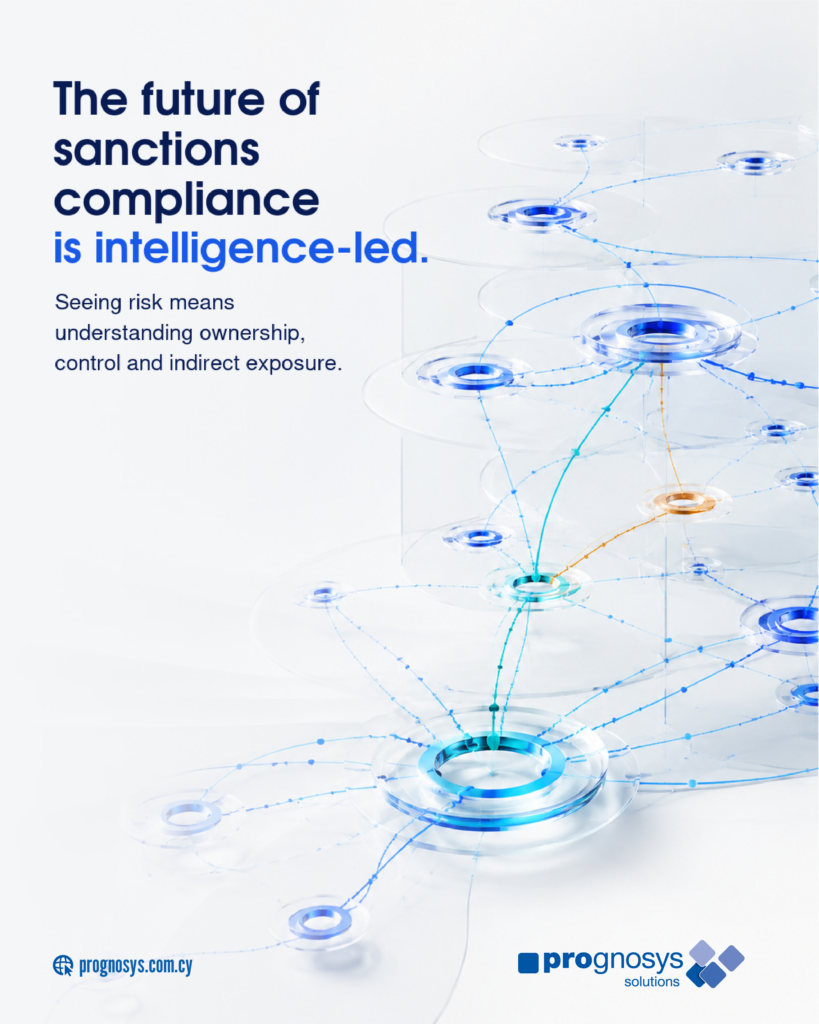
Sanctions compliance is becoming increasingly complex. Financial institutions must screen customers and transactions against evolving sanctions regimes while also identifying exposure that may not be immediately visible through a direct name match. The challenge lies in the relationships behind the data. A customer may not appear on a sanctions list, yet exposure can exist through ownership structures, connected entities, intermediaries, counterparties or jurisdictions. As these relationships become harder to assess manually, traditional screening alone provides only part of the picture. From Screening to Context Effective sanctions compliance increasingly requires institutions to understand the context surrounding a potential risk. This means connecting customer information with beneficial ownership, transactional activity, related parties and other relevant risk indicators. A screening alert becomes significantly more useful when investigators can establish how the parties involved are connected and assess the nature of that exposure. Linkage analysis plays an important role here. By identifying relationships across customers, entities and transactions, compliance teams can uncover patterns that may remain hidden when information is reviewed across separate systems. Data Quality Matters The effectiveness of sanctions monitoring depends heavily on the quality of the underlying information. Incomplete customer records, inconsistent entity identifiers or fragmented ownership data can make relationships difficult to identify and increase the number of alerts requiring manual review. Strong data governance therefore becomes an important component of sanctions compliance. Institutions need reliable information, consistent processes and clear ownership of the data used for screening and investigation. Technology Supporting Better Investigation Technology can help compliance teams manage this complexity by bringing screening, transaction monitoring, risk profiling and relationship analysis into a connected environment. Advanced analytics can help investigators prioritise cases and identify patterns across large volumes of information. The objective is to give compliance professionals a clearer basis for assessment and decision-making while maintaining appropriate human oversight. Prognosys Solutions, together with its sister company Fusion Compliance Tech, co-developed the Fusion AML Suite to support this approach. The platform combines key AML and financial crime capabilities, including name screening, SWIFT filtering, transaction monitoring, risk profiling and linkage analysis. Integrated with the Prognosys DMS Solution, it also supports KYC processes from customer onboarding through ongoing monitoring. Building a Stronger View of Risk As sanctions regimes and financial networks become increasingly complex, institutions need the ability to understand relationships as well as individual alerts. The direction is clear. Effective sanctions compliance increasingly depends on connecting the right information, identifying relevant relationships and giving compliance teams the tools to investigate risk efficiently and with confidence. For financial institutions, that means moving from isolated screening towards a clearer, intelligence-led view of sanctions exposure.
AMLR readiness starts with strong foundations
The European Union’s new Anti Money Laundering Regulation, Regulation (EU) 2024/1624, will apply from 10 July 2027, introducing a more harmonised framework for preventing money laundering and terrorist financing across the EU. EUR Lex For financial institutions, preparation involves more than updating policies before the application date. The requirements need to be translated into practical controls, reliable data and clearly defined workflows across the organisation. A key starting point is the quality of existing customer records. Institutions should assess whether customer identification details, beneficial ownership information, risk classifications and due diligence evidence are complete, current and consistently structured. Information may exist within a customer file while still being difficult to validate, retrieve or use effectively across different systems. Institutions should also review how their customer due diligence, risk assessment and ongoing monitoring processes operate in practice. Each workflow needs clear responsibilities, approval routes and supporting evidence, particularly when information changes or a case requires escalation. This work requires collaboration between compliance, legal, operations, onboarding, technology and data management teams. A shared understanding of responsibilities helps connect regulatory interpretation with everyday decision making and ensures that each compliance action remains traceable. Starting early gives institutions time to identify data and process requirements, prioritise areas for remediation and build an operating model that can evolve as further guidance and technical standards are introduced. At Prognosys Solutions, we believe effective AMLR readiness begins when compliance is embedded into the organisation’s data, systems and operational processes. Strong foundations today can support a more consistent, adaptable and sustainable compliance environment for the regulatory landscape ahead.
From periodic reviews to continuous KYC – Customer risk does not follow a review calendar
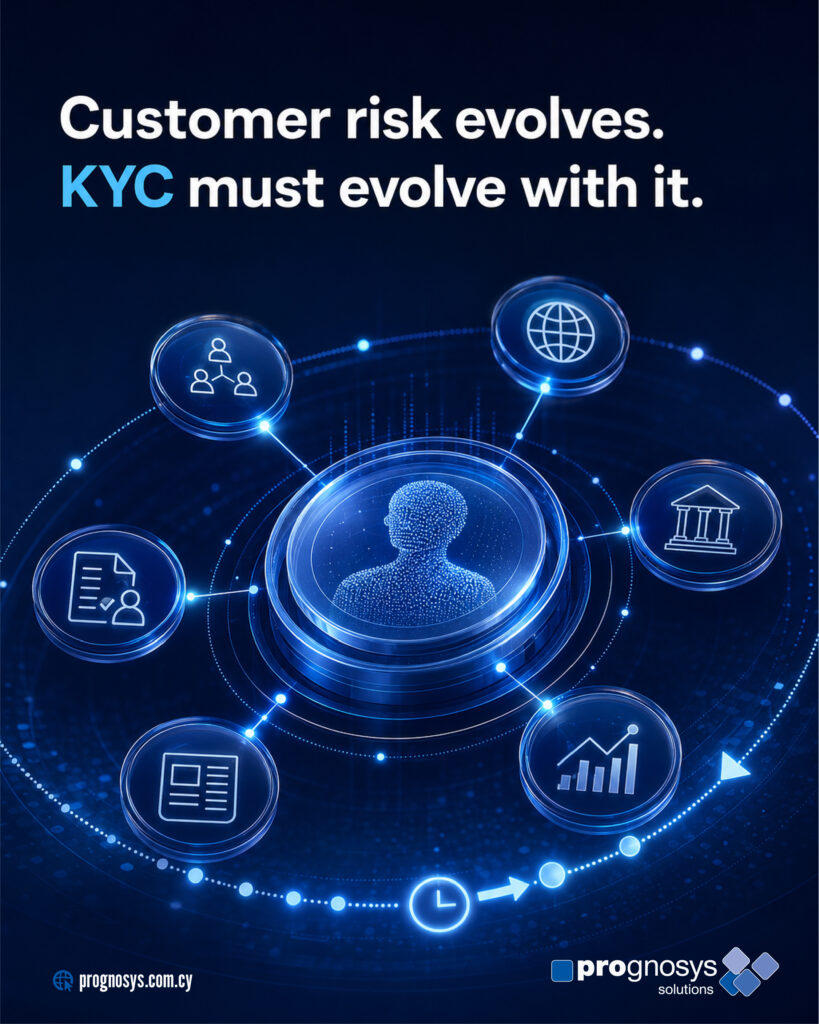
Traditional KYC processes have relied on defined stages: customer verification at onboarding, scheduled periodic reviews and additional checks when a concern arises. Yet a customer’s circumstances can change at any point during the relationship. Changes in beneficial ownership, corporate structure, sanctions exposure, transaction activity or adverse media can materially alter a customer’s risk profile between review dates. By the time the next scheduled assessment takes place, the institution may already be working with outdated information. This gap is driving the shift from periodic reviews to continuous KYC. Continuous KYC applies a risk-driven approach to customer monitoring. Relevant data and risk indicators are assessed throughout the relationship, allowing significant changes to trigger a timely reassessment rather than waiting for the next review cycle. The value lies in identifying which developments require action. Compliance teams need to distinguish material risk events from routine updates and direct each case into the correct review, escalation or approval process. Without this distinction, continuous monitoring can create additional alerts and manual work rather than improve oversight. Effective continuous KYC therefore requires clear trigger rules, proportionate responses and a complete audit trail. Institutions must be able to demonstrate what prompted a review, which information was assessed, how the risk rating changed and why a specific decision was made. Strong operational foundations are equally important. Connected customer data, consistent workflows and effective governance help institutions maintain a current and reliable view of customer risk. Fragmented systems can create gaps in visibility, duplicate effort and make compliance decisions harder to explain, verify and trace. Prognosys Solutions supports financial institutions in strengthening the data, reporting and control frameworks required for continuous KYC. By connecting information, workflows and governance processes, institutions can improve the timeliness, consistency and traceability of customer risk decisions. Continuous KYC is therefore an operational shift, rather than a change in review frequency. It requires institutions to move from fixed checkpoints towards ongoing, risk-based oversight throughout the customer lifecycle.
Framework 4.2 is not a single deadline. It is a sequence.
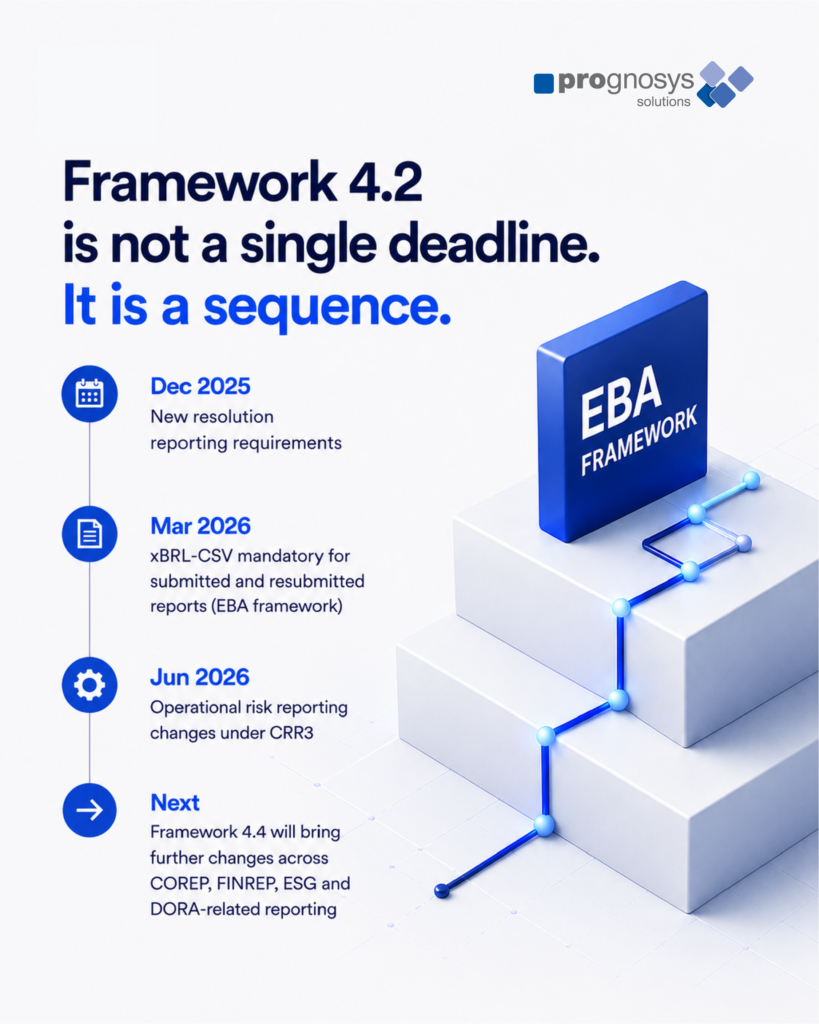
Regulatory reporting programmes are often viewed through the lens of individual implementation dates. In practice, however, major framework changes rarely arrive as a single event. They unfold through a sequence of interconnected milestones that place continuous demands on reporting teams, systems, and processes. Framework 4.2 is a clear example. The journey began with the December 2025 reference date, which introduced new resolution reporting requirements. From the March 2026 reference date, xBRL-CSV became mandatory for submitted and resubmitted reports under the EBA framework, introducing additional technical and operational considerations for reporting institutions. More recently, June 2026 brought the first operational risk reporting changes under CRR3, further extending the scope of change. For many institutions, the challenge has not been understanding the individual requirements. The challenge has been delivering each phase consistently, accurately, and across reporting environments that were often developed over many years and designed for different regulatory expectations. The pace of change is not slowing. Framework 4.4 is expected to introduce further developments across COREP, FINREP, ESG reporting, and DORA-related reporting requirements. At the same time, the EBA’s reporting simplification initiative points towards additional structural changes expected from September 2027. Viewed together, these developments highlight an important shift. Success is increasingly determined not by how effectively organisations respond to individual deadlines, but by how well they manage continuous regulatory change. Financial institutions that perform strongly in this environment typically focus on building reporting infrastructures capable of absorbing multiple waves of regulatory evolution. Stable data foundations, scalable reporting processes, strong governance, and coordinated delivery models help reduce disruption and support more efficient implementation as frameworks continue to evolve. Framework 4.2 therefore represents more than a reporting update. It illustrates the broader reality of modern regulatory reporting, where change is ongoing and operational readiness becomes a strategic capability. At Prognosys Solutions, we help financial institutions build reporting environments designed to support consistency, stability, and long-term adaptability across evolving regulatory frameworks.
What the EBA’s reporting simplification proposal means for financial institutions
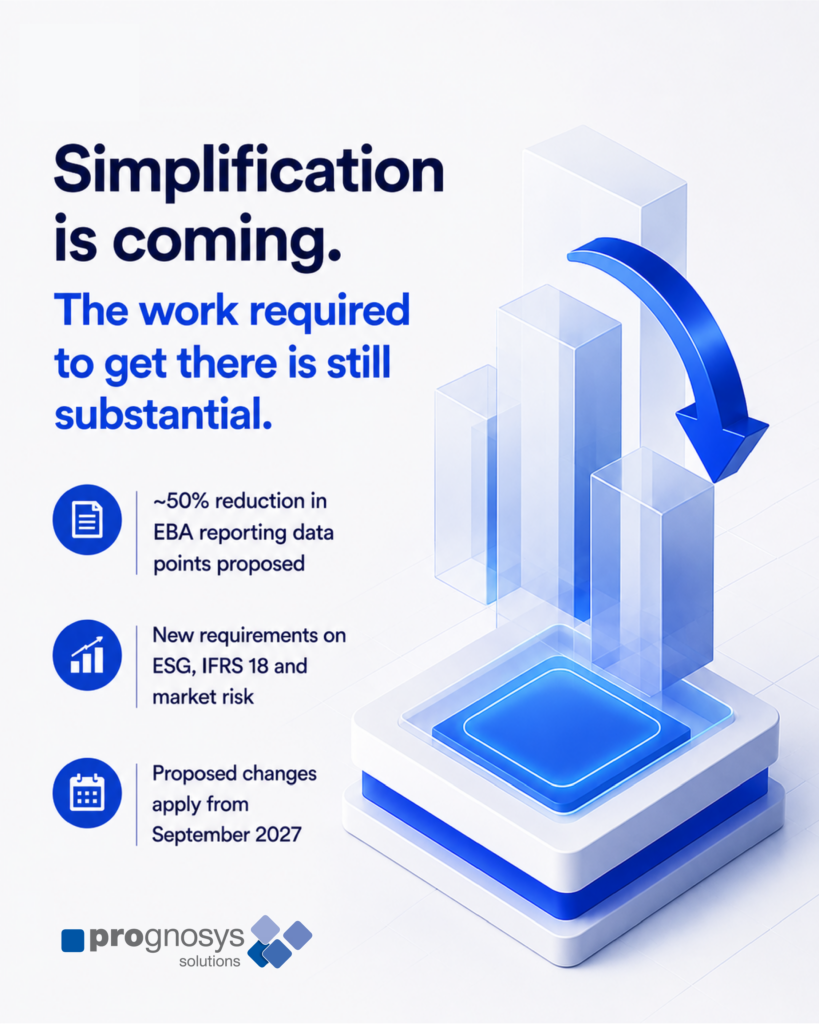
The European Banking Authority’s recent proposal to reduce supervisory reporting data points by approximately 50% has attracted significant attention across the financial sector. At first glance, the initiative appears to signal a lighter reporting burden and a simpler regulatory environment for reporting institutions. For many organisations, the natural reaction may be to assume that future reporting demands will become easier to manage. However, the proposal deserves a closer look. The proposed reduction represents a net outcome rather than a straightforward removal of requirements. At the same time that existing reporting obligations are being reviewed, new requirements linked to ESG disclosures, IFRS 18 implementation, and market risk reporting continue to emerge. The practical impact will therefore vary significantly depending on the institution’s size, business model, regulatory profile, and reporting obligations. Timing is another important consideration. The proposed simplification measures are expected to apply from September 2027. Before then, institutions remain focused on a demanding reporting agenda that includes Framework 4.4, further operational risk reporting developments under CRR3, DORA-related reporting requirements, and other ongoing regulatory initiatives. This creates an important reality for financial institutions. Simplification may be part of the long-term direction of travel, but the short and medium-term environment remains characterised by continuous change. As reporting frameworks evolve, organisations are increasingly recognising the value of building flexible reporting environments that can absorb change efficiently. Institutions that invest in stronger data governance, scalable reporting processes, and connected reporting infrastructures are often better positioned to adapt to both new requirements and future simplification initiatives. The conversation therefore extends beyond the number of data points being reported. It is increasingly about how organisations manage reporting change, maintain consistency across frameworks, and create sustainable reporting capabilities for the years ahead. At Prognosys Solutions, we support financial institutions in navigating evolving regulatory reporting requirements through robust reporting frameworks, scalable processes, and delivery models designed for long-term adaptability..
Prognosys Solutions achieves ISO/IEC 27001:2022 certification
Prognosys Solutions is pleased to announce that it has successfully achieved ISO/IEC 27001:2022 certification, the internationally recognised standard for Information Security Management Systems (ISMS). The certification demonstrates that our Information Security Management System has been independently assessed and found to meet the requirements of ISO/IEC 27001:2022, confirming our commitment to protecting information assets, managing information security risks and maintaining robust security practices across our organisation. For organisations operating in highly regulated environments, information security is fundamental. As a trusted RegTech provider, we continuously invest in secure processes, effective governance and the protection of our clients’ information. Achieving this certification is an important milestone that reflects the dedication of our team and our commitment to continuous improvement. It provides our clients and partners with additional confidence that security remains a core priority in the design, delivery and operation of our solutions. We thank everyone who contributed to this achievement and look forward to continuing to support our clients with secure, reliable and innovative regulatory technology solutions.
Strong reporting starts with trusted data
Regulatory reporting is becoming more demanding, not only in volume but in the level of consistency, transparency, and control expected from financial institutions. Across Europe, supervisory priorities continue to emphasise stronger risk data aggregation and reporting, while the wider reporting agenda is moving toward more integrated, standardised, and data-driven frameworks. In this environment, the quality of reporting cannot be judged only at the point of submission. It is determined much earlier, by the quality of the data behind it. When data is accurate, accessible, and well-governed across systems and teams, reporting becomes more reliable. It also gives institutions a stronger basis for oversight, decision-making, and risk management. The ECB has explicitly stressed that strong risk data aggregation and risk reporting capabilities are essential for sound risk management and effective decision-making. This is why trusted data matters so much. Reporting challenges often begin long before a template is completed or a submission is due. In many organisations, data still sits across multiple systems, processes rely on manual intervention, and teams spend significant time validating figures before they are ready for review. Over time, this can create delays, add operational pressure, and make it harder to respond efficiently when requirements change. That conclusion is an inference based on the ECB’s focus on reporting quality and the EBA’s ongoing work to improve semantic consistency, integrated reporting, and data quality. A stronger reporting environment starts by building trust in the flow of information. That means clearer data ownership, better consistency across systems, stronger controls, and reporting processes designed to support accuracy from the start. The direction of travel across the EU supports this clearly. The EBA’s 2026 work programme highlights the evolution of DPM 2.0, the development of an integrated reporting system, and work linked to the EU Supervisory Data Strategy. Its 2026 reporting simplification work also points to simpler, smarter, and more proportionate reporting supported by stronger data architecture. For organisations, the value goes beyond compliance. When data foundations are stronger, reporting becomes easier to manage with consistency and confidence. Teams can spend less time correcting and reconciling information, and more time on review, interpretation, and action. That helps support better internal visibility and a more resilient operating environment. This is an inference grounded in the ECB’s view that strong risk data aggregation and reporting capabilities support both sound risk management and operational efficiency. This matters even more as the broader regulatory environment becomes more exacting. DORA has applied since 17 January 2025, reinforcing the expectation that financial entities must be able to withstand, respond to, and recover from ICT-related disruptions. In practice, that raises the importance of data reliability, process discipline, and reporting environments that can hold up under pressure. At Prognosys Solutions, we support organisations in strengthening the reporting environments behind critical regulatory and operational requirements. By helping connect data, improve visibility, and streamline reporting processes, we help teams work with greater confidence and build reporting structures designed for long-term value.