
Framework 4.2 is not a single deadline. It is a sequence.
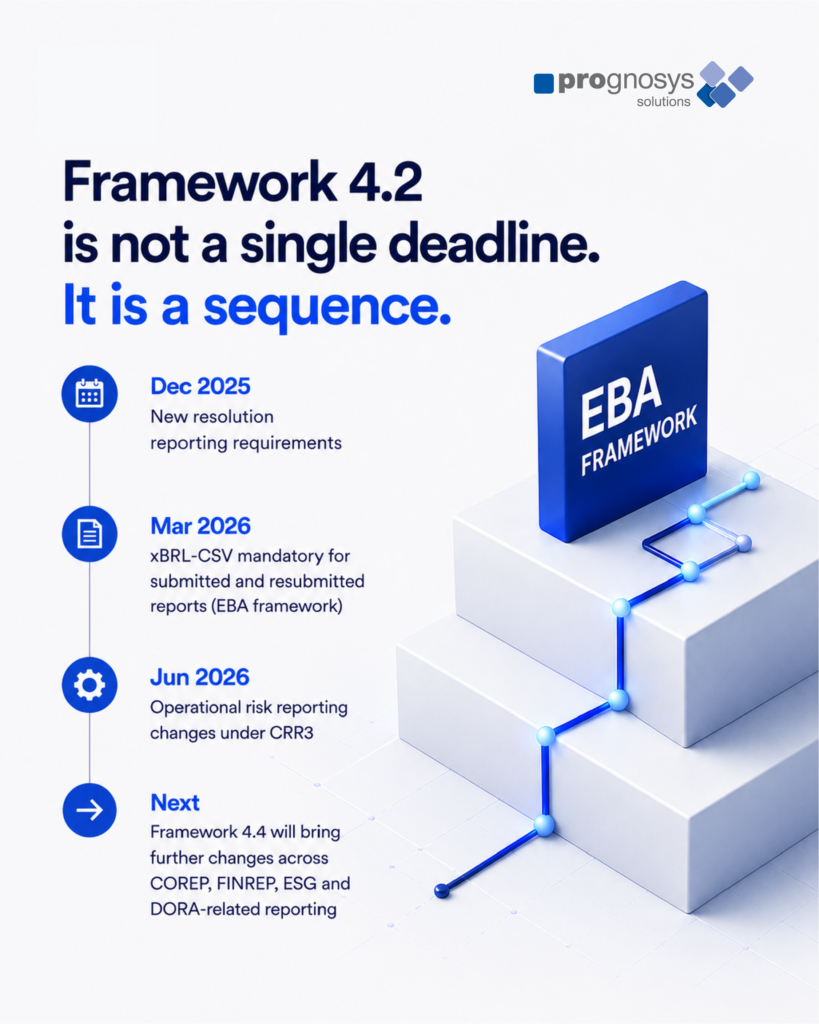
Regulatory reporting programmes are often viewed through the lens of individual implementation dates. In practice, however, major framework changes rarely arrive as a single event. They unfold through a sequence of interconnected milestones that place continuous demands on reporting teams, systems, and processes. Framework 4.2 is a clear example. The journey began with the December 2025 reference date, which introduced new resolution reporting requirements. From the March 2026 reference date, xBRL-CSV became mandatory for submitted and resubmitted reports under the EBA framework, introducing additional technical and operational considerations for reporting institutions. More recently, June 2026 brought the first operational risk reporting changes under CRR3, further extending the scope of change. For many institutions, the challenge has not been understanding the individual requirements. The challenge has been delivering each phase consistently, accurately, and across reporting environments that were often developed over many years and designed for different regulatory expectations. The pace of change is not slowing. Framework 4.4 is expected to introduce further developments across COREP, FINREP, ESG reporting, and DORA-related reporting requirements. At the same time, the EBA’s reporting simplification initiative points towards additional structural changes expected from September 2027. Viewed together, these developments highlight an important shift. Success is increasingly determined not by how effectively organisations respond to individual deadlines, but by how well they manage continuous regulatory change. Financial institutions that perform strongly in this environment typically focus on building reporting infrastructures capable of absorbing multiple waves of regulatory evolution. Stable data foundations, scalable reporting processes, strong governance, and coordinated delivery models help reduce disruption and support more efficient implementation as frameworks continue to evolve. Framework 4.2 therefore represents more than a reporting update. It illustrates the broader reality of modern regulatory reporting, where change is ongoing and operational readiness becomes a strategic capability. At Prognosys Solutions, we help financial institutions build reporting environments designed to support consistency, stability, and long-term adaptability across evolving regulatory frameworks.
What the EBA’s reporting simplification proposal means for financial institutions
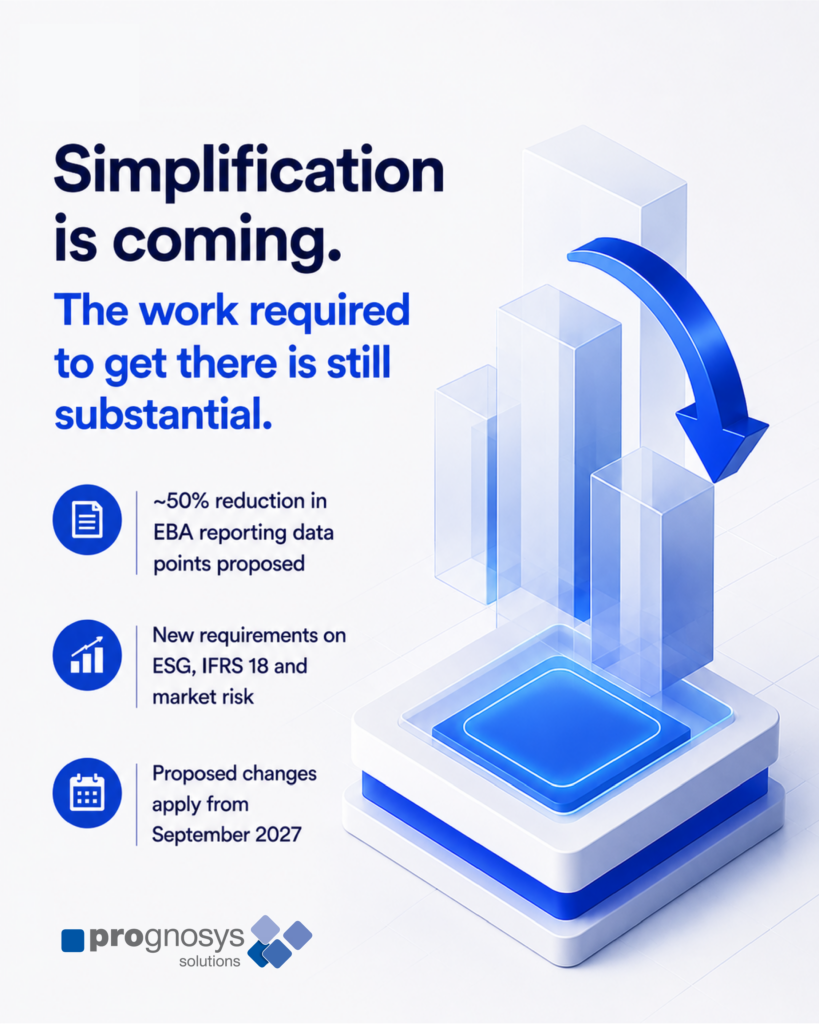
The European Banking Authority’s recent proposal to reduce supervisory reporting data points by approximately 50% has attracted significant attention across the financial sector. At first glance, the initiative appears to signal a lighter reporting burden and a simpler regulatory environment for reporting institutions. For many organisations, the natural reaction may be to assume that future reporting demands will become easier to manage. However, the proposal deserves a closer look. The proposed reduction represents a net outcome rather than a straightforward removal of requirements. At the same time that existing reporting obligations are being reviewed, new requirements linked to ESG disclosures, IFRS 18 implementation, and market risk reporting continue to emerge. The practical impact will therefore vary significantly depending on the institution’s size, business model, regulatory profile, and reporting obligations. Timing is another important consideration. The proposed simplification measures are expected to apply from September 2027. Before then, institutions remain focused on a demanding reporting agenda that includes Framework 4.4, further operational risk reporting developments under CRR3, DORA-related reporting requirements, and other ongoing regulatory initiatives. This creates an important reality for financial institutions. Simplification may be part of the long-term direction of travel, but the short and medium-term environment remains characterised by continuous change. As reporting frameworks evolve, organisations are increasingly recognising the value of building flexible reporting environments that can absorb change efficiently. Institutions that invest in stronger data governance, scalable reporting processes, and connected reporting infrastructures are often better positioned to adapt to both new requirements and future simplification initiatives. The conversation therefore extends beyond the number of data points being reported. It is increasingly about how organisations manage reporting change, maintain consistency across frameworks, and create sustainable reporting capabilities for the years ahead. At Prognosys Solutions, we support financial institutions in navigating evolving regulatory reporting requirements through robust reporting frameworks, scalable processes, and delivery models designed for long-term adaptability..
Prognosys Solutions achieves ISO/IEC 27001:2022 certification
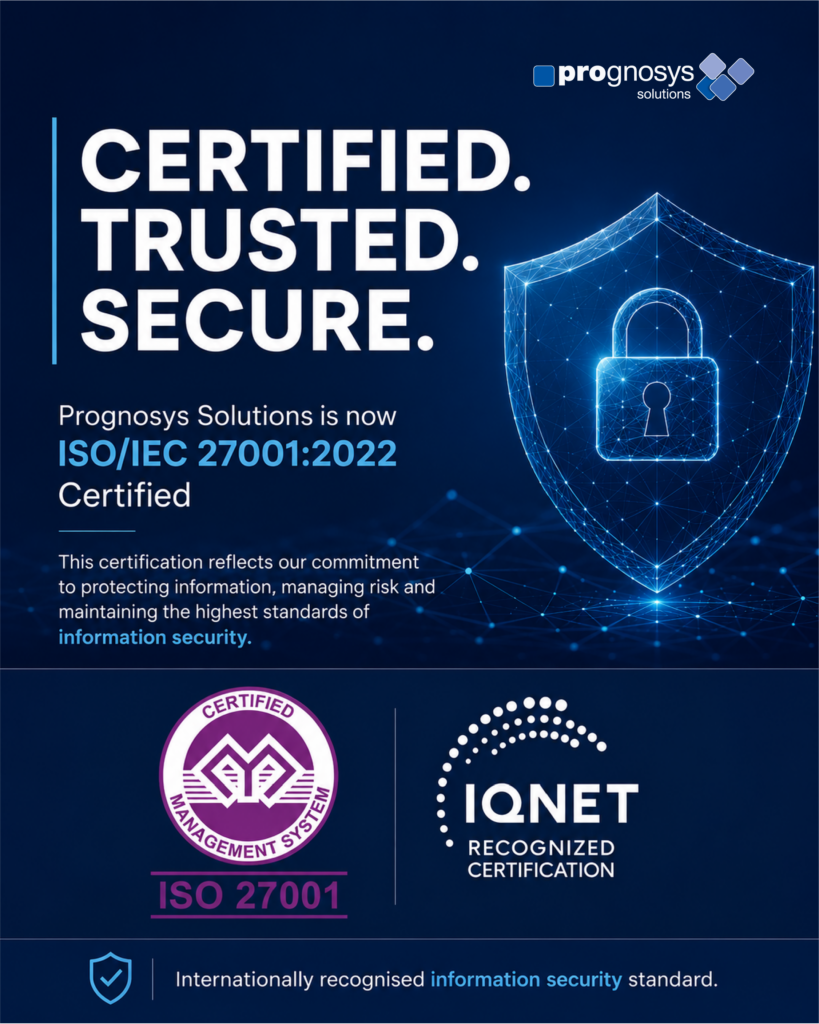
Prognosys Solutions is pleased to announce that it has successfully achieved ISO/IEC 27001:2022 certification, the internationally recognised standard for Information Security Management Systems (ISMS). The certification demonstrates that our Information Security Management System has been independently assessed and found to meet the requirements of ISO/IEC 27001:2022, confirming our commitment to protecting information assets, managing information security risks and maintaining robust security practices across our organisation. For organisations operating in highly regulated environments, information security is fundamental. As a trusted RegTech provider, we continuously invest in secure processes, effective governance and the protection of our clients’ information. Achieving this certification is an important milestone that reflects the dedication of our team and our commitment to continuous improvement. It provides our clients and partners with additional confidence that security remains a core priority in the design, delivery and operation of our solutions. We thank everyone who contributed to this achievement and look forward to continuing to support our clients with secure, reliable and innovative regulatory technology solutions.
Strong reporting starts with trusted data
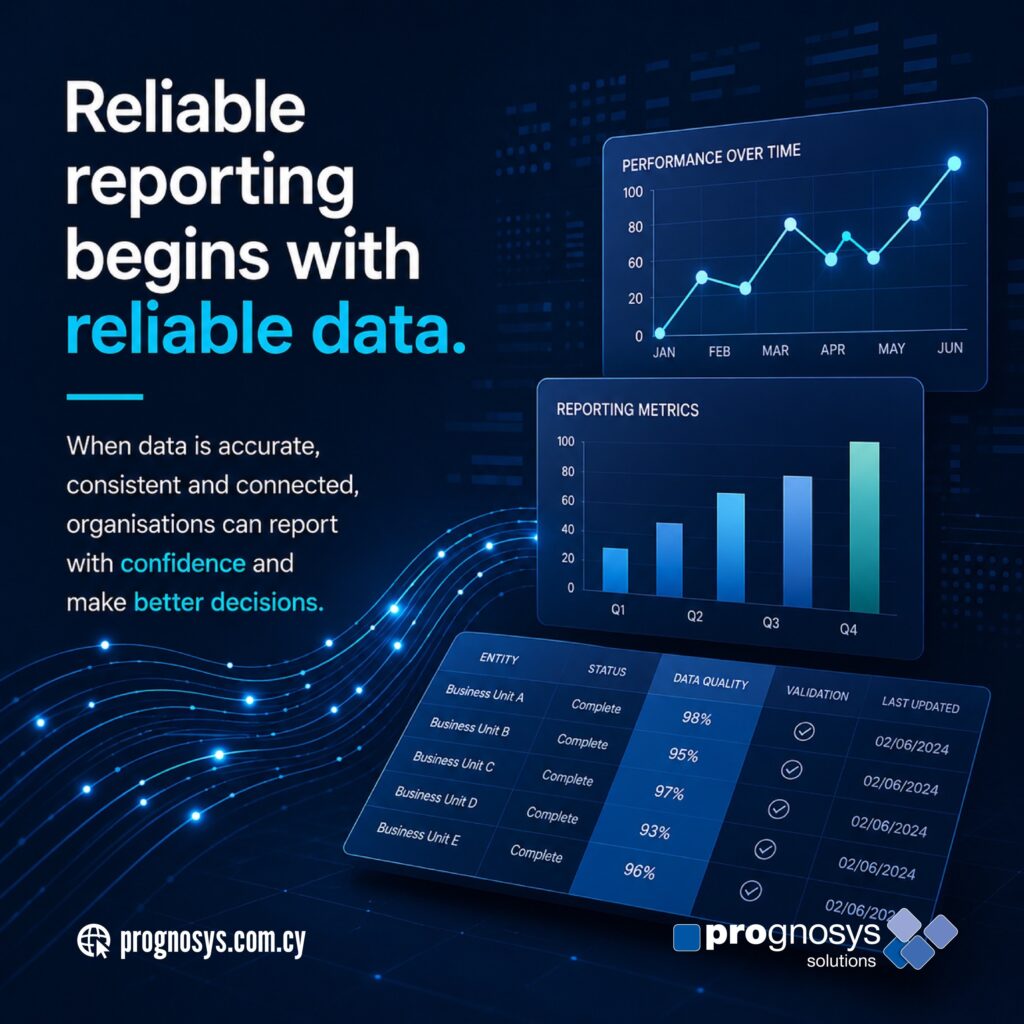
Regulatory reporting is becoming more demanding, not only in volume but in the level of consistency, transparency, and control expected from financial institutions. Across Europe, supervisory priorities continue to emphasise stronger risk data aggregation and reporting, while the wider reporting agenda is moving toward more integrated, standardised, and data-driven frameworks. In this environment, the quality of reporting cannot be judged only at the point of submission. It is determined much earlier, by the quality of the data behind it. When data is accurate, accessible, and well-governed across systems and teams, reporting becomes more reliable. It also gives institutions a stronger basis for oversight, decision-making, and risk management. The ECB has explicitly stressed that strong risk data aggregation and risk reporting capabilities are essential for sound risk management and effective decision-making. This is why trusted data matters so much. Reporting challenges often begin long before a template is completed or a submission is due. In many organisations, data still sits across multiple systems, processes rely on manual intervention, and teams spend significant time validating figures before they are ready for review. Over time, this can create delays, add operational pressure, and make it harder to respond efficiently when requirements change. That conclusion is an inference based on the ECB’s focus on reporting quality and the EBA’s ongoing work to improve semantic consistency, integrated reporting, and data quality. A stronger reporting environment starts by building trust in the flow of information. That means clearer data ownership, better consistency across systems, stronger controls, and reporting processes designed to support accuracy from the start. The direction of travel across the EU supports this clearly. The EBA’s 2026 work programme highlights the evolution of DPM 2.0, the development of an integrated reporting system, and work linked to the EU Supervisory Data Strategy. Its 2026 reporting simplification work also points to simpler, smarter, and more proportionate reporting supported by stronger data architecture. For organisations, the value goes beyond compliance. When data foundations are stronger, reporting becomes easier to manage with consistency and confidence. Teams can spend less time correcting and reconciling information, and more time on review, interpretation, and action. That helps support better internal visibility and a more resilient operating environment. This is an inference grounded in the ECB’s view that strong risk data aggregation and reporting capabilities support both sound risk management and operational efficiency. This matters even more as the broader regulatory environment becomes more exacting. DORA has applied since 17 January 2025, reinforcing the expectation that financial entities must be able to withstand, respond to, and recover from ICT-related disruptions. In practice, that raises the importance of data reliability, process discipline, and reporting environments that can hold up under pressure. At Prognosys Solutions, we support organisations in strengthening the reporting environments behind critical regulatory and operational requirements. By helping connect data, improve visibility, and streamline reporting processes, we help teams work with greater confidence and build reporting structures designed for long-term value.