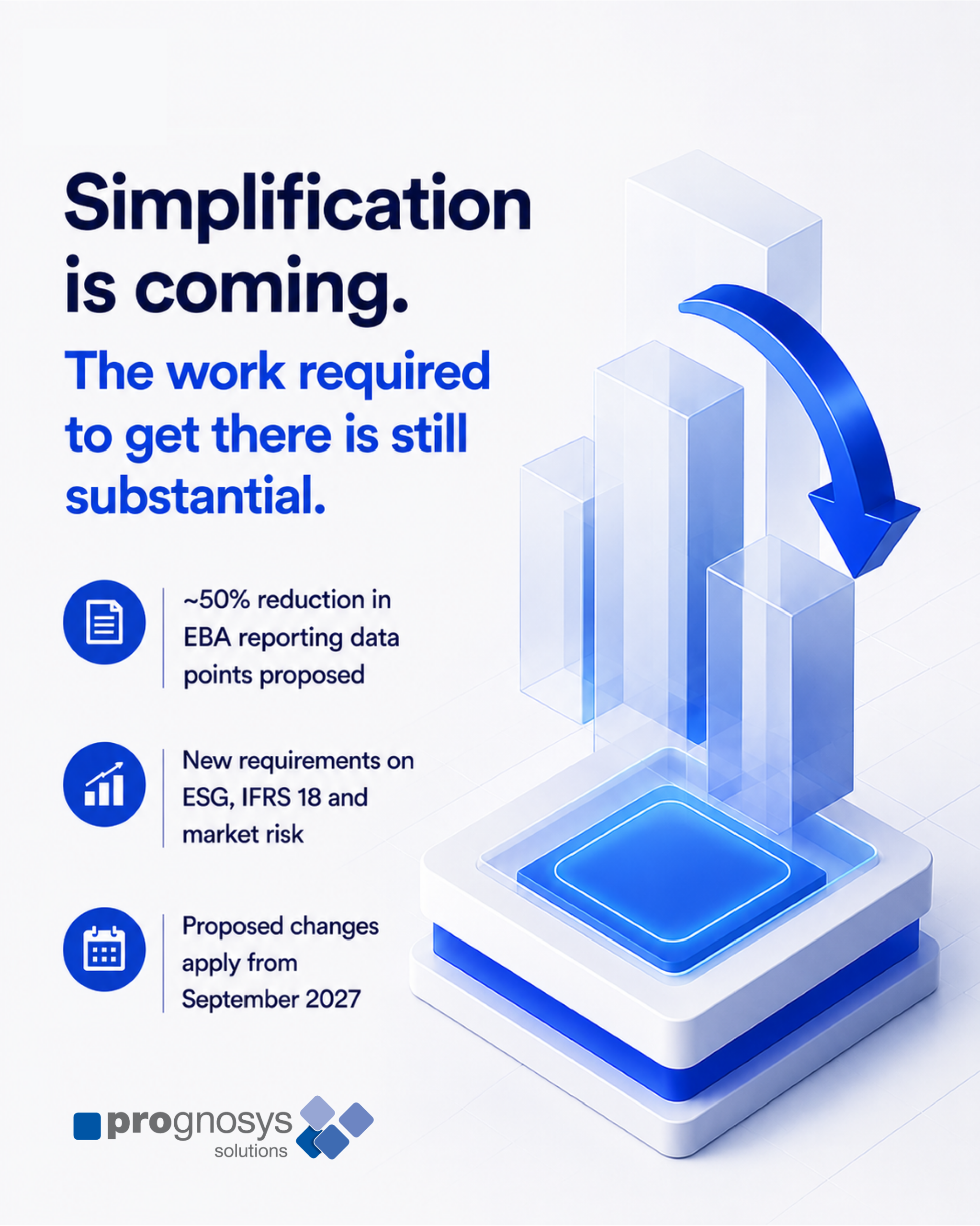
The European Banking Authority’s recent proposal to reduce supervisory reporting data points by approximately 50% has attracted significant attention across the financial sector. At first glance, the initiative appears to signal a lighter reporting burden and a simpler regulatory environment for reporting institutions.
For many organisations, the natural reaction may be to assume that future reporting demands will become easier to manage. However, the proposal deserves a closer look.
The proposed reduction represents a net outcome rather than a straightforward removal of requirements. At the same time that existing reporting obligations are being reviewed, new requirements linked to ESG disclosures, IFRS 18 implementation, and market risk reporting continue to emerge. The practical impact will therefore vary significantly depending on the institution’s size, business model, regulatory profile, and reporting obligations.
Timing is another important consideration. The proposed simplification measures are expected to apply from September 2027. Before then, institutions remain focused on a demanding reporting agenda that includes Framework 4.4, further operational risk reporting developments under CRR3, DORA-related reporting requirements, and other ongoing regulatory initiatives.
This creates an important reality for financial institutions. Simplification may be part of the long-term direction of travel, but the short and medium-term environment remains characterised by continuous change.
As reporting frameworks evolve, organisations are increasingly recognising the value of building flexible reporting environments that can absorb change efficiently. Institutions that invest in stronger data governance, scalable reporting processes, and connected reporting infrastructures are often better positioned to adapt to both new requirements and future simplification initiatives.
The conversation therefore extends beyond the number of data points being reported. It is increasingly about how organisations manage reporting change, maintain consistency across frameworks, and create sustainable reporting capabilities for the years ahead.
At Prognosys Solutions, we support financial institutions in navigating evolving regulatory reporting requirements through robust reporting frameworks, scalable processes, and delivery models designed for long-term adaptability..